

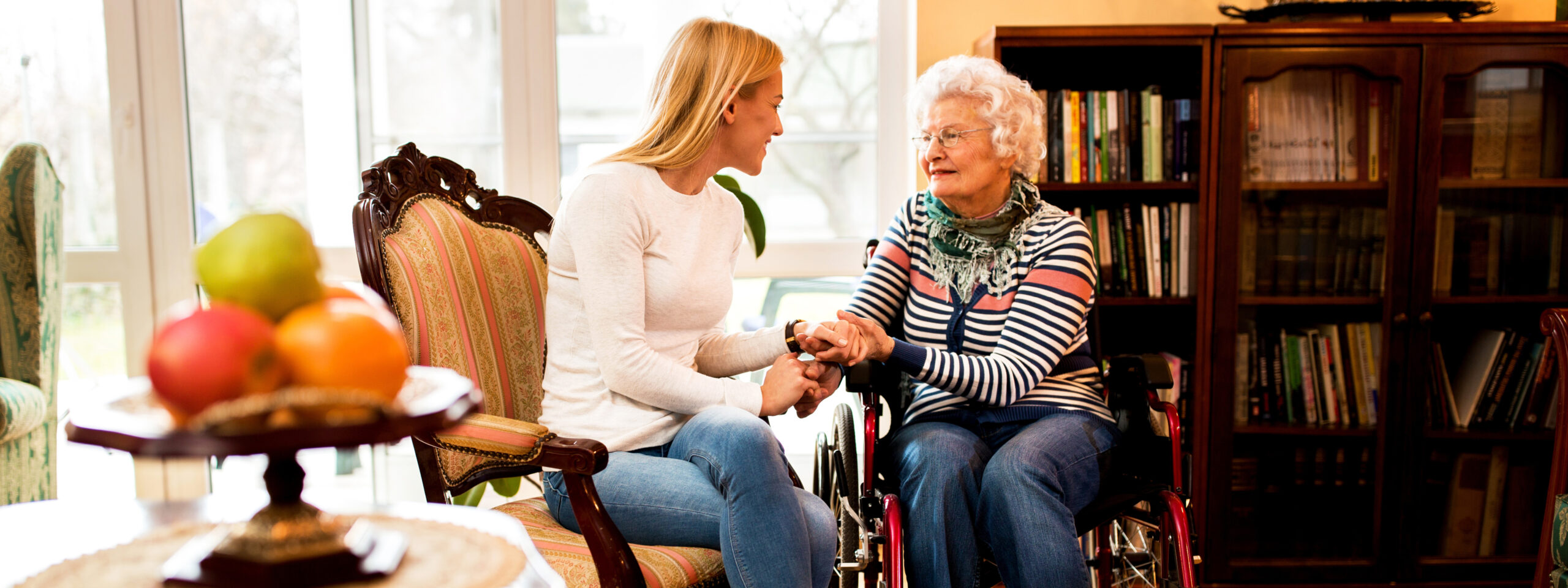
What to do when your parents need care?
When the time comes that your mother or father needs care, you as their son or daughter face particular demands. Fear, uncertainty and many decisions often shape everyday life. Here we would like to give you some information and tips on how you can nevertheless handle this situation positively – for your parents and for yourself.
The first signs of a need for care
Growing older and even illness do not necessarily mean that your parents need care. Rather, it is individual signs that point to a need for care. These can be both physical and mental changes. Physical signs include declining mobility, difficulties with daily activities such as personal hygiene or eating, and falls. Mental signs are often forgetfulness, confusion and disorientation. Also look out for unexplained injuries or changes in your parents’ behaviour. If you notice one or more of these changes, the person may need support. It is then up to you to take the necessary steps in good time and ensure the best possible care.
First steps when care is needed
As soon as you notice signs that your parents need care, you should take the first steps towards the right support. A structured approach is important to ensure the transition to the best possible care.
1. Talk to your parents
- Talk to your parents with empathy and openness
- Find out about their needs and wishes
- Discuss possible support measures
2. Doctor’s appointments and medical assessments
- Make an appointment with a doctor for a thorough examination
- Have a medical report drawn up on their state of health
- You will receive a diagnosis and possible treatment options
3. Medical records
- Collect and organise all medical reports and documents
- Create a clearly arranged folder or digital filing system
- Update the records and findings regularly
These first steps will help you gain clarity about how your parents’ health is developing and approach the next steps in a targeted way.
The daily challenges
Everyday life with parents who need care will confront you as a caregiver with new challenges, which can also be a burden. But you do not have to manage all the tasks alone. Today there are many institutions and people offering support, from professional care services and care advice to family caregiver groups.
What is the right kind of care?
Your parents can be cared for at home or in a care home. Here are some aspects that are important.
Care at home
Many older people want to stay at home even if they need care. To a certain extent, this is possible. A care service can help with everyday life on an hourly basis, for example. And if you take on the care of your parents yourself, you will receive advice and support from a Spitex (home care) organisation.
Care in a care home
In certain cases, a place in a care home is essential. In that case, choosing the right facility is crucial. Draw up a list of criteria that are particularly important to you and visit the care homes in person.
Financial aspects of care
Spitex as home care
Perhaps you can or want to care for your parents yourself. In this case, it may be worth being employed by a Spitex organisation such as pflegehero. Here you receive a gross hourly wage of CHF 36–42 for what is known as basic care – for example help with getting up, dressing, washing and similar support.
Care credits
If you personally care for your parents, you can apply for care credits at the AHV (Swiss old-age and survivors’ insurance) compensation office of your canton. These credits are not paid out, but are credited towards your old-age pension. You can find more information on this topic on the website www.ahv-iv.ch.
Care allowances
In some cantons and municipalities, family caregivers also receive flat-rate allowances. However, the criteria for these and the amount and duration of payment are not regulated uniformly. As a rule, a minimum number of care hours is required, and the allowance is calculated on a daily basis. You can find more information on the website of the Federal Office of Public Health.
Long-term care insurance and health insurer
Switzerland has no statutory long-term care insurance. In the event of a need for care, Swiss health insurers normally pay for care services in kind, but not cash benefits. If you would like to find out more, contact your health insurer.
Duty to support parents in need of care
In Switzerland, there is a duty to support your parents under the so-called duty of support among relatives, Art. 328 of the Swiss Civil Code (ZGB). However, this only applies under certain conditions. These include:
- Income, pension and supplementary benefits to the AHV & IV (disability insurance) are not sufficient to cover the minimum cost of living.
- There is a family relationship. Entitlement exists only for children, grandchildren, parents and grandparents, but not for siblings or more distant relatives.
- The person liable to provide support lives in comfortable financial circumstances
- There is no other duty of support
If the family’s resources are not sufficient, social assistance can be claimed for the costs of care.
The emotional side of care
If, as a son or daughter, you suddenly have to deal with caring for your parents, fear and uncertainty are perfectly normal emotional companions. That makes it all the more important that you also pay attention to your own psychological limits. We recommend talking about it with your family and friends and, if necessary, seeking outside help.
Remember the advance healthcare directive
In the event of a serious illness in older people, an advance healthcare directive is crucial. With it, your parents specify which medical measures should be taken if they are no longer able to decide for themselves.
An advance healthcare directive should be drawn up even if there is no illness yet. It may spare you and your parents difficult situations. At the time of drafting, the person concerned must have capacity of judgement. So address the topic of an advance healthcare directive in good time. You can find more information and a template to print out on the website of the Swiss Confederation at www.ch.ch/gesundheit/patientenverfügung.
More articles

MiGeL list: what is Switzerland’s List of Aids and Appliances?
READ MORE >
13th AHV pension: what changes for pensioners in Switzerland from 2026
READ MORE >