
Caring for relatives at home – and getting paid for it
Three years ago, Bruno Wermelinger became dependent on care after a brain haemorrhage. The fact that he is now largely independent again is thanks to his wife Theres, extensive therapy and Spitex (home care) support at home.
In September 2020, in the middle of the coronavirus pandemic, the hitherto rather tranquil life of the Wermelinger couple changed in an instant. Bruno suffered a brain haemorrhage in the middle of the night. His wife found him and immediately called the emergency services. Bruno survived. But his left side was completely paralysed, he could no longer speak and he had lost his short-term memory. He spent three months in a rehabilitation clinic in Zurzach – and on top of that he was infected with coronavirus at Christmas. “I didn’t see him for seven weeks,” says his wife Theres.
A care bed and a new bathroom
Bruno Wermelinger recovered to the point where he was allowed to return home at the beginning of 2021. But he was dependent on care and used a wheelchair for a while. “I couldn’t walk, couldn’t get up by myself, couldn’t shower by myself,” says the now 79-year-old. Every day, a nurse from the healthcare services company reha at home comes to the Wermelingers’ home and takes care of basic care. The physiotherapy, speech therapy and occupational therapy that the former Bülach town councillor had started in rehab are also continued at home. To make this possible, the Wermelingers first had to make room for a care bed and secondly carry out some structural alterations to their flat. Theres lists them: “Today we have a walk-in shower with a seat, grab bars next to the toilet and a higher washbasin without a cabinet underneath so that Bruno can sit down.”
A long road
The former mechanical engineer continued to recover. He learnt to speak again, the paralysis on his left side receded bit by bit, and the motor skills in his hand improved. But the road is long – for Theres too, who takes care of everything her husband used to do. She manages the finances and paperwork, does small DIY jobs around the flat, organises Bruno’s
many appointments and helps him with personal care when no nurse is in the house. To do this, the now 74-year-old has had to acquire a number of skills. “I learnt from the nursing staff at the rehabilitation clinic and from reha at home how to lift Bruno out of bed and into the wheelchair, for example. That was very important, because I had to be able to support him.”
Pay for providing care
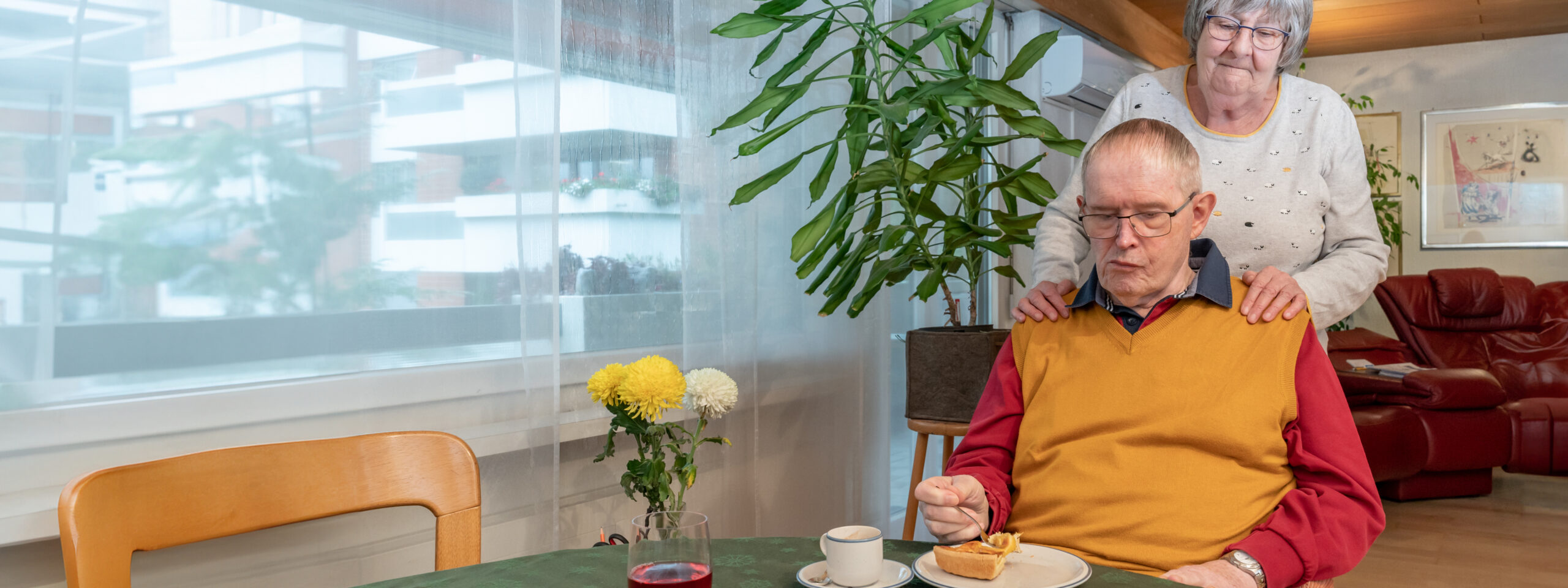
At first, Theres provided all this care free of charge. Later, she is employed as a family caregiver by pflegehero, a cooperation with reha at home, and receives a salary. “For me, though, the money is secondary,” she says. “What matters most to me is that I always have someone to turn to.” Julia Walthard, Head of Nursing at pflegehero, explains the concept: “Employed family caregivers must complete a nursing assistant course within one year of starting their employment. They also commit to providing certain care services for their relative and to documenting the course of care.” These regular reports are reviewed, as are the services provided and their quality. pflegehero, for its part, undertakes to pay, coach and guide the family caregivers and to stand by them whenever needed.
“What matters most to me is that I always have someone to turn to.”
Good progress
Bruno Wermelinger has recovered from his brain haemorrhage to the point where he can manage his everyday life almost independently again. He can walk without help, his ability to speak has fully returned and his short-term memory is making good progress. But he still needs support with some things, as he says. “Theres still helps me with personal care, for example drying myself after a shower. And I can’t put on my socks by myself, because I’d have to bend forward too far and could fall.” Theres’ company is also important when Bruno runs errands outside the house, as it keeps him safe. His wife adds: “Bruno is diabetic and needs insulin regularly. Before the brain haemorrhage, he gave himself the injections. Today I help him, because the motor skills of his left hand don’t work perfectly yet. Typing on a keyboard is also difficult for him. But he manages!”
Text Manuela Talenta Photos Studio Filipa Peixeiro
More articles
MiGeL list: what is Switzerland’s List of Aids and Appliances?
READ MORE >
13th AHV pension: what changes for pensioners in Switzerland from 2026
READ MORE >